SASPX63K: A New Approach to AI, Blockchain, and Digital Communities
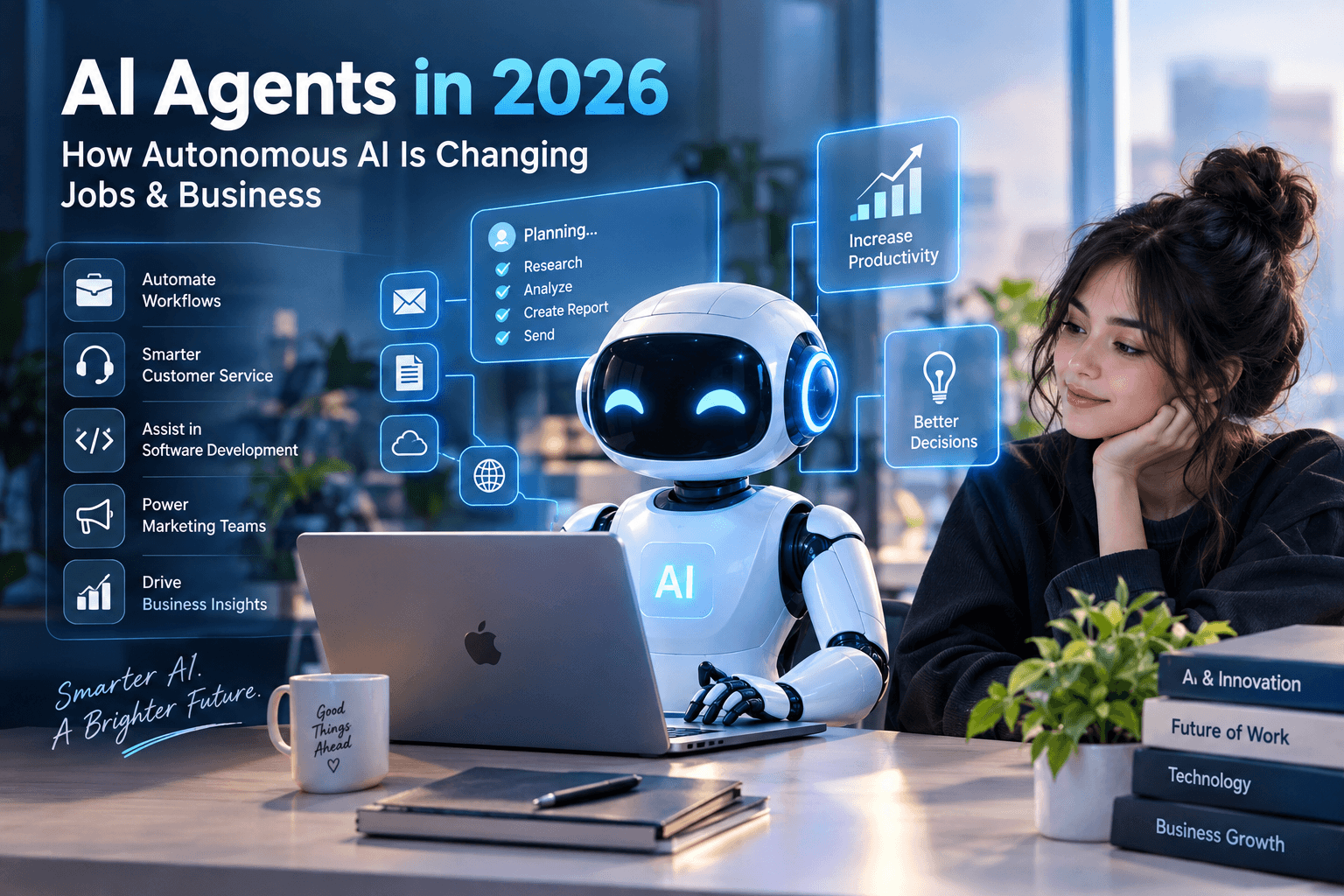
Artificial intelligence is moving beyond simple chatbots and basic automation. In 2026, AI agents are becoming increasingly capable of planning tasks, using digital tools, analyzing information, and completing multi-step workflows with limited human intervention.
From customer service and software development to marketing and business operations, autonomous AI agents are changing how organizations approach everyday work. Instead of simply responding to a prompt, these systems can work toward a defined goal and take multiple actions to achieve it.
What Are AI Agents?
AI agents are software systems designed to perform tasks autonomously based on a goal or instruction. They can reason through problems, access tools, process information, and adjust their actions based on results.
A traditional AI chatbot might answer a question. An AI agent, by contrast, could potentially research information, organize the results, create a report, and send it through an appropriate business system.
The exact capabilities depend on the specific agent, software, permissions, and safeguards involved.
Why AI Agents Are Growing in 2026
Several developments are driving interest in AI agents:
More capable foundation models
Better reasoning and planning
Integration with business software
Improved ability to use digital tools
More sophisticated automation platforms
Growing demand for productivity improvements
Businesses are increasingly exploring agents because they can connect multiple steps of a workflow instead of automating only one isolated task.
How AI Agents Are Changing Business
1. Automating Repetitive Work
AI agents can assist with repetitive digital tasks such as organizing information, summarizing documents, handling routine inquiries, and preparing reports.
This can allow employees to spend more time on work requiring judgment, creativity, communication, and specialized knowledge.
2. Transforming Customer Service
AI-powered systems can answer common customer questions, retrieve relevant information, and help route complicated cases to human employees.
More advanced agent systems can potentially handle several stages of a customer-service workflow rather than simply generating a response.
3. Improving Software Development
AI coding agents are becoming an important area of development. Depending on their capabilities, they can help developers:
Write code
Explain existing code
Find bugs
Generate tests
Refactor software
Work with documentation
Human developers still need to review generated code, particularly for security, reliability, and complex applications.
4. Supporting Marketing Teams
Marketing teams can use AI agents to assist with tasks such as content research, campaign analysis, audience research, keyword analysis, and reporting.
Instead of using separate tools for every small step, agent-based systems can potentially coordinate several activities within one workflow.
5. Helping With Business Research
AI agents can process large amounts of information and organize findings into useful summaries.
For example, an agent might assist with competitor research by collecting publicly available information, organizing it, and highlighting relevant changes for human review.
AI Agents and the Future of Jobs
One of the biggest questions surrounding autonomous AI is how it will affect employment.
AI agents are likely to change many job responsibilities rather than simply eliminating entire occupations. Some repetitive tasks may become increasingly automated, while demand can grow for people who can supervise AI systems, verify their outputs, manage workflows, and apply domain expertise.
New roles may also develop around AI implementation, governance, evaluation, and agent management.
The impact will vary significantly by industry and occupation.
Skills That May Become More Valuable
As AI handles more routine digital work, several human skills remain important:
Critical thinking
Problem-solving
Creativity
Communication
Leadership
Domain expertise
AI literacy
Quality control
Ethical decision-making
Learning how to work effectively with AI tools could become an increasingly useful professional skill.
Challenges of AI Agents
Despite their potential, autonomous AI systems have important limitations.
Accuracy
AI agents can make mistakes or misunderstand instructions. Human oversight remains important for consequential tasks.
Security
Agents that can access company systems or sensitive information need carefully designed permissions and security controls.
Privacy
Organizations must consider how personal and confidential data is collected, processed, stored, and shared.
Reliability
An agent completing multiple steps can potentially compound an early mistake into a larger problem. Monitoring and approval mechanisms can help reduce this risk.
Accountability
Businesses need clear rules about who is responsible when an AI-powered workflow produces an incorrect or harmful result.
AI Agents vs Traditional Automation
Traditional automation generally follows predefined rules.
AI agents can be more flexible because they can interpret natural-language instructions, reason through certain tasks, and adapt their actions based on available information.
However, traditional automation can still be preferable for predictable processes where reliability and strict control are priorities.
The two technologies are therefore likely to coexist.
What Businesses Should Consider Before Using AI Agents
Organizations considering AI agents should first identify workflows where automation could provide measurable value.
Important considerations include:
Define the business objective.
Start with a limited workflow.
Set appropriate permissions.
Keep humans involved in high-impact decisions.
Monitor agent performance.
Protect sensitive information.
Measure accuracy and productivity.
Establish clear accountability.
A gradual approach can help organizations identify both benefits and limitations before expanding deployment.
The Future of Autonomous AI
AI agents are becoming an important part of the broader AI ecosystem. As models, tools, and integrations improve, agents may become capable of handling increasingly complex workflows.
The most significant change may not be AI replacing every worker, but humans and AI systems dividing work differently.
Businesses that understand where autonomous systems are useful—and where human judgment remains essential—will be better positioned to adapt to the changing workplace.
FAQs
1. What are AI agents?
AI agents are software systems that can pursue goals by reasoning, using tools, and completing multiple tasks with varying degrees of autonomy.
2. How are AI agents different from chatbots?
Chatbots primarily respond to conversations, while AI agents can perform multi-step tasks and interact with tools or software systems.
3. Are AI agents replacing jobs in 2026?
AI agents are automating some tasks and changing job responsibilities. The effect differs across industries and occupations.
4. Can AI agents work without humans?
Some agents can perform certain workflows autonomously, but human oversight is often important, especially for sensitive or high-impact decisions.
5. How are businesses using AI agents?
Businesses are exploring agents for customer support, research, software development, marketing, data processing, and workflow automation.
6. Can AI agents write software?
Yes. AI coding agents can assist with code generation, debugging, testing, documentation, and other software-development tasks.
7. Are AI agents safe?
Safety depends on how an agent is designed, what permissions it receives, what data it can access, and how closely its actions are monitored.
8. What industries can use AI agents?
Potential applications exist across technology, finance, healthcare administration, retail, education, marketing, logistics, and many other sectors.
9. Will AI agents replace human workers?
Their impact is likely to vary. Some tasks may become automated while other responsibilities shift toward supervision, judgment, creativity, and specialized expertise.
10. What skills are useful in an AI-driven workplace?
Critical thinking, communication, creativity, domain expertise, problem-solving, and AI literacy can all be valuable.
11. Can AI agents access company databases?
They can potentially interact with databases when they are specifically integrated and authorized to do so.
12. What is autonomous AI?
Autonomous AI refers to systems capable of carrying out tasks or workflows with limited human intervention after receiving an objective or instruction.
13. Are AI agents expensive?
Costs vary significantly depending on the model, software platform, number of users, data requirements, and complexity of the workflow.
14. Can small businesses use AI agents?
Yes. Smaller organizations can use AI-powered tools for selected tasks such as customer support, content workflows, research, and administrative work.
15. What is an AI agent workflow?
It is a sequence in which an AI system performs multiple related actions to accomplish a broader objective.
16. Can AI agents make decisions?
They can make certain automated decisions within the rules and permissions provided to them, but organizations may require human approval for important decisions.
17. What are AI agentic workflows?
Agentic workflows combine AI reasoning and tool use to complete multi-step processes rather than performing only one isolated task.
18. Why are companies interested in AI agents?
Companies are exploring them because they may reduce repetitive work, improve workflow efficiency, and help employees handle large volumes of information.
19. What are the biggest risks of AI agents?
Important risks include inaccurate outputs, security vulnerabilities, privacy issues, unauthorized actions, and insufficient human oversight.
20. What is the future of AI agents?
AI agents are expected to become more integrated with software and business workflows, although their capabilities and reliability will continue to vary by system and application.
21. Can AI agents work with multiple apps?
Yes, when they have the necessary integrations and permissions, agents can potentially coordinate actions across multiple applications.
22. Are AI agents useful for students?
They can assist with research, organization, studying, coding, brainstorming, and productivity, provided students verify information and follow academic rules.
23. What is the difference between AI automation and AI agents?
Traditional automation usually follows predefined rules, while AI agents can use AI reasoning to handle more flexible, multi-step tasks.
24. Do AI agents need internet access?
Not always. Some agents can operate using local systems and data, while others require internet access or external services for particular tasks.
25. How can companies prepare for AI agents?
Companies can identify suitable workflows, train employees, establish security controls, test systems, and create policies for responsible AI use.
26. Can AI agents improve productivity?
They can potentially improve productivity by handling repetitive or time-consuming digital tasks, although actual results depend on implementation and oversight.
27. Can AI agents make mistakes?
Yes. They can misunderstand instructions, produce inaccurate information, or take inappropriate actions, which is why monitoring and verification matter.
28. Will AI agents create new jobs?
AI adoption can create demand for roles involving AI development, implementation, evaluation, governance, training, and oversight, although employment effects vary by sector.
29. What is the role of humans with AI agents?
Humans can define goals, supervise systems, review outputs, handle exceptions, provide expertise, and make decisions requiring judgment.
30. Are AI agents the future of business automation?
They are an important emerging approach to automation, particularly for complex workflows, but conventional automation and human work will continue to have important roles.